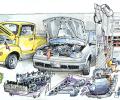
An increase in sales across all categories in the automobile industry, has made need for higher working capital inevitable.

Operating margins have been the primary driver of corporate earnings in India in recent quarters, despite revenue growth suffering from weak consumer demand. Companies across sectors have reported a sharp improvement in earnings before interest, tax, depreciation, and amortisation (Ebitda) margins over the past two years, benefiting from lower commodity and energy prices. Higher margins more than compensated for slower revenue growth, resulting in double-digit growth in net profit for five consecutive quarters.

RIL, HDFC twins, M&M, Infosys among the top losers for the day.

The BSE Midcap and Smallcap indices underperformed the largecaps and ended over 1% lower.

Yes Bank, Wipro, Kotak Bank, M&M, Sun Pharma, Maruti, HDFC, Hero MotoCorp, Infosys, TCS, L&T, Bajaj Auto and HUL were among the top gainers, rising up to 6 per cent.

Investors sought to book profits at attractive valuations after recent run up in last few trading sessions.

Capital expenditure by Indian companies is likely to see an uptick in the upcoming quarters as capacity utilisation has surpassed the critical threshold of 75 per cent, and numerous companies have deleveraged their balance sheets, according to analysts. The first quarter of the current financial year has shown improved profitability, driven by a decrease in input prices. This, according to analysts at Care Ratings, should stimulate a revival in the private capex cycle.

Sun Pharma was the biggest loser among Sensex components, plunging 3.94 per cent, followed by Tata Steel falling 3.12 per cent.

Home-grown automotive players like Tata Motors, Ashok Leyland, Bajaj Auto, Hero Honda, TVS Motors and Maruti Suzuki are augmenting the use of plastics in engine components in an ambitious effort to reduce dependence on key metals like steel and aluminium, all of which have witnessed stupendous rise of 35-50 per cent in the past 5 months.

Had you invested Rs 10,000 each in JSW Steel, Titan Company and Bajaj Finance 20 years ago, when they were just penny stocks (trading below Rs 10), you would have become a millionaire by now.

Top laggards in the Sensex pack included HDFC, ICICI Bank, TCS, HCL Tech, Kotak Bank, Asian Paints, TechM and HUL, dropping up to 2.67 per cent.

From the 30-share basket, 28 scrips suffered losses. Over 200 stocks were at their 52-week low in Tuesday's trade.

Samvat 2070 was a great year for top Indian conglomerates in the stock markets.

Yes Bank was the biggest gainer in the Sensex pack, rallying 11.48 per cent amid reports that private equity firms have showed interest in buying a major stake in the private sector lender.

buyer. Car companies on Monday reported double-digit increases in sales in April 2010 over April 2009.

Ajit Mishra, vice president, Research, Religare Broking, answers your queries.

At the close, the 50-share NSE Nifty was at 8,611.15, up 19.90 points, or 0.23 per cent, after moving between 8,637.15 and 8,555.20.

Ajit Mishra, vice president, research, Religare Broking, answers your queries.

Technology firm Wipro has a "high probability" of getting included in the benchmark Sensex, while two-wheeler major Bajaj Auto is the "most likely" deletion candidate, according to an analysis done by Brian Freitas, an analyst at independent research provider Smartkarma. The changes to the index will be announced mid-November, and will become effective from December 17. The December review uses the 6-month average market capitalisation and trading turnover data between May 1 and October 31 to determine changes.

The broader markets, however, outperformed the benchmark indices -- BSE Midcap and Smallcap indices ended up 0.6%-1%.

'Cyrus was always very different. He would think before acting.'

Stocks of companies having operations and exports to Europe were the top losers.
After a string of foreign deals in the last few years, including Tata Motors' purchase of Land Rover and Jaguar brands from Ford for $2.3 billion this year, attempts by Indian companies to acquire assets abroad are increasingly hitting roadblocks. At least, the recent attempts by Indian companies suggest so.
In the broader markets, the BSE Midcap and Smallcap indices extended gains and were up over 1% each

The index rising for the fourth straight session surged 564 points.

Coal India was the biggest gainer on both Sensex and Nifty

The rally was led by IT stocks, with TCS and Infosys rising up to 5 per cent. Yes Bank, on the other hand, was the biggest loser on both the bourses, cracking nearly 12 per cent

Markets end almost flat, bluechips in focus.
Indian corporates have raised around $11.9 billion through overseas borrowing in the first five months of 2007-08, according to the Reserve Bank of India (RBI) data on external commercial borrowings (ECB).

Gains were led by index heavyweights Reliance Industries and Infosys.

The 30-share Sensex ended down 208 points at 28,261 and the 50-share Nifty closed 64 points lower at 8,571.

The BSE Sensex zoomed 318 points to end at 33,351.57, while the broader Nifty spurted 88 points to 10,242.65.
Firms generated free cash flows in 2013-14, for the first time since the 2008 Lehman crisis

'The growth drivers are mostly invisible, but the growth is undeniable at least for now,' notes Debashis Basu.

BSE Metal and Capital Goods indices plunged over 2% followed by counters like Consumer Durables, Auto, Banks and Realty, all falling down between 1-2%.

Ajit Mishra, vice president, Research, Religare Broking, answers your queries.

Ajit Mishra, vice president, research, Religare Broking, answers your queries.

How much do you know about the Vibrant Gujarat Global Summit 2024?

Ajit Mishra, vice president, Research, Religare Broking, answers your queries:

Concessional rate of tax on dividends received by Indian companies from foreign subsidiaries will be done away with from April 1, a change that may hamper global expansion of Indian companies and compel some firms to move their headquarters out of India to geographies such as Singapore and Dubai. At present, dividends received by Indian companies from their foreign subsidiaries are subject to a concessional tax rate of 15 per cent under Section 115BBD of the Income Tax (I-T) Act. The provisions of this section shall not apply from assessment year 2023-24 onwards, according to the Finance Bill.
 © 2026 Rediff.com - Advertise with us - Disclaimer - Privacy Policy - Sitemap - Feedback - About us - Terms of use - Grievances